
The New Leadership Capability Every Product Professional Needs in the AI Era

Prasadd Bartakke

AI is making product development faster. It can generate interfaces, analyse information, write code, create content, and automate parts of execution.
But speed does not determine whether a team is solving the right problem.
AI cannot independently decide what is worth creating, which evidence matters, how competing priorities should be balanced, or how people should align around a shared direction. These remain human responsibilities.
Over the past several weeks, I worked alongside professionals with different roles, levels of experience, and responsibilities across the product ecosystem. Despite these differences, the conversations repeatedly centred on the same challenges:
- connecting business intent with human needs;
- aligning stakeholders with different priorities;
- simplifying complex systems and experiences;
- working effectively with AI; and
- making sound decisions when the path forward is unclear.
These are not limited to product managers or formal leaders. They affect designers, researchers, engineers, business analysts, consultants, and everyone involved in shaping products, services, experiences, workflows, and intelligent systems.
Functional Expertise Is No Longer Enough
Functional expertise remains essential. Designers must understand behaviour and interaction. Engineers must understand technology and feasibility. Researchers must produce relevant evidence. Business analysts must connect goals, processes, and requirements. Product managers must establish direction and priorities.
But products are no longer created within individual functions.
They are shaped across interconnected business, customer, technology, operational, and organisational systems. A technically sound solution may fail to address the right customer need. Strong research may not influence a decision. A well-managed roadmap may still move the product in the wrong direction.
The professionals who create greater impact are those who can connect these perspectives and turn them into a clear, shared direction.
The Leadership Capability That Matters
This form of leadership is not based on title, authority, or seniority.
It is the ability to:
- frame the right problem;
- connect business intent with human needs;
- understand the wider system;
- align diverse stakeholders;
- use evidence to guide decisions;
- simplify complexity without ignoring important dependencies;
- work critically and effectively with AI; and
- make decisions that create business and human value.
Leadership becomes visible when someone improves the quality of the conversation, brings clarity to ambiguity, and helps others make a better decision.
As AI makes execution faster and more accessible, this capability becomes more important, not less. The ability to generate outputs will become common. The ability to decide what deserves to be created will remain a differentiator.
At yuj.dna, this is the capability we help professionals develop: thinking across functions, aligning stakeholders, working effectively with AI, and making stronger decisions.
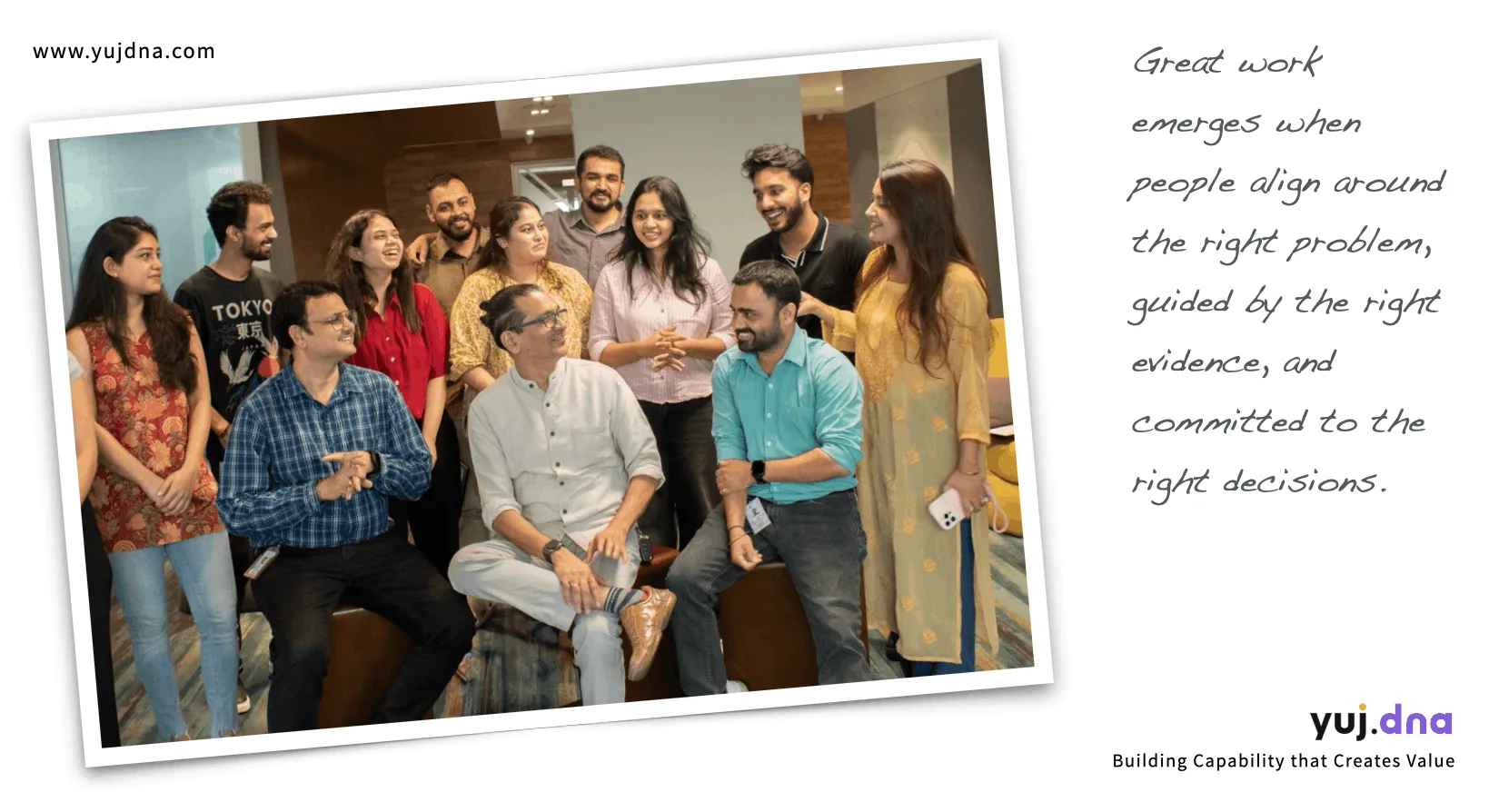
Great work emerges when people align around the right problem, the right evidence, and the right decisions.