
Why Informed Product Decision-Making Is the Next Business Advantage

Prasadd Bartakke

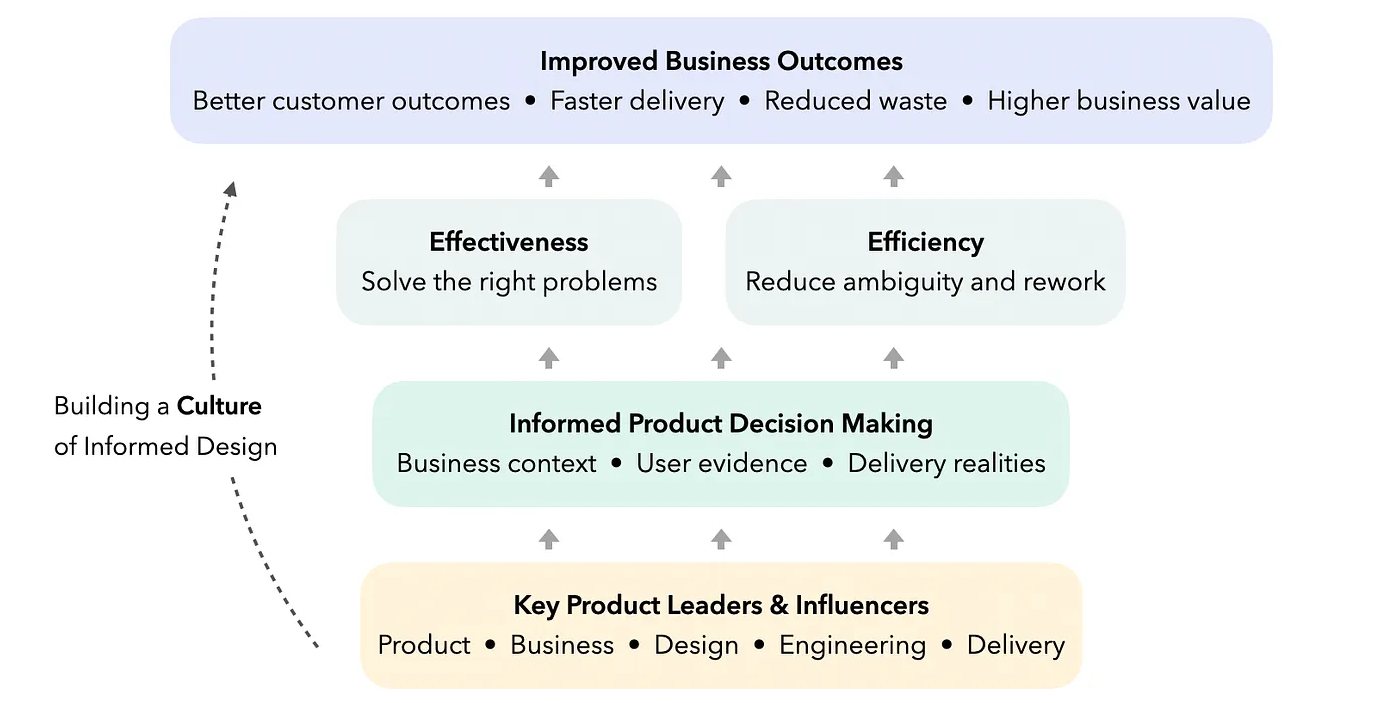
AI is accelerating product creation. The next business advantage will come from building informed product decision-making across product, business, design, engineering and delivery teams.
This acceleration is useful, but it also changes where competitive advantage comes from.
When execution becomes faster and tools become widely available, the quality of the product depends increasingly on the quality of the decisions behind it. Organisations will not differentiate themselves merely by producing more features or moving faster. They will differentiate themselves by identifying the right problems, understanding the business context, interpreting user evidence, working within delivery realities, and making better trade-offs across the product lifecycle.
The next business advantage lies in building a culture of informed product decision-making across the product ecosystem.
Product quality is shaped long before design or development begins
Many product failures are diagnosed at the point where they become visible: poor adoption, rework, confusing experiences, delayed delivery, weak business outcomes, or low customer satisfaction.
The cause often appears much earlier.
A weak product decision may begin with an unclear business objective, an assumption treated as evidence, an incomplete understanding of user behaviour, or a requirement that has not been examined critically. Once that decision enters the system, design, engineering and delivery teams may execute it efficiently while still moving in the wrong direction.
AI can accelerate this process. It can help teams produce more options, analyse more information and complete tasks faster. It can also accelerate poorly framed work when the underlying decisions remain weak.
Speed increases the value of judgement.
Informed product decisions require more than design capability
Designers play an important role in shaping products and experiences, but product decisions are rarely made by design alone. They emerge through the interaction of product, business, design, engineering, delivery and other stakeholders.
Each function contributes a different form of evidence and constraint:
- Business brings strategic context, commercial priorities and expected value.
- Product connects customer needs, market opportunity and execution choices.
- Design brings user understanding, behavioural insight and experience quality.
- Engineering brings technical feasibility, architecture and system implications.
- Delivery brings sequencing, dependencies, capacity and operational reality.
The quality of the decision depends on how well these perspectives are connected.
A culture of informed design therefore cannot remain limited to the design team. It must become a broader product capability: the ability of leaders and practitioners across functions to use business context, user evidence and delivery realities to make more considered decisions.
Better decisions improve both effectiveness and efficiency
Organisations often pursue efficiency by improving tools, processes and delivery speed. These interventions matter, but they do not compensate for solving the wrong problem.
Effectiveness comes first: Are we addressing the right opportunity? Are we creating value for the right users? Are we solving a meaningful problem? Are we aligned with the business intent?
Once those questions are answered well, efficiency becomes easier. Teams face less ambiguity, fewer reversals, reduced rework and clearer prioritisation. Design and engineering effort is used with greater purpose. Stakeholder conversations become more productive because decisions are supported by evidence rather than preference.
This creates two forms of value:
Effectiveness: solving the right problems and creating outcomes that matter.
Efficiency: reducing ambiguity, avoidable rework and wasted execution.
Together, they improve customer outcomes, business value, return on investment and organisational agility.
The real shift is cultural
A single workshop or training programme can strengthen individual capability. Sustained business impact requires the organisation to reinforce the same way of thinking through its leadership, decision forums, product reviews, planning practices and delivery systems.
A culture of informed product decision-making becomes visible when teams routinely ask:
- What business outcome are we trying to influence?
- What evidence supports this decision?
- What do we know about the user, and what are we still assuming?
- What trade-offs are we making?
- What are the system and delivery implications?
- How will we know whether the decision created value?
These questions should not depend on one strong designer, product manager or leader. They must become part of how the product organisation works.
Where capability building matters
Tools can support decisions. Frameworks can structure them. AI can accelerate analysis and execution.
The organisation still needs people who can interpret context, connect evidence, recognise ambiguity, question assumptions, make trade-offs and take ownership of outcomes.
That capability must be built across the product ecosystem.
The objective is larger than improving design outputs. It is to strengthen how product, business, design, engineering and delivery leaders think together. When this happens, informed design becomes part of informed product decision-making, and product decision-making becomes a source of business advantage.
As AI accelerates product creation, the organisations that gain the most will not simply produce faster.
They will decide better.