
The Hidden Cost of Capability That Never Gets Developed

Prasadd Bartakke

Organisations measure many forms of loss: delays, poor productivity, rework, missed revenue and customer complaints.
But there is another cost that is much harder to see.
The capability people never get the opportunity to develop.
This matters particularly in product and design organisations. Companies increasingly expect professionals to understand business context, frame better problems, influence direction, make decisions and take greater ownership.
Yet everyday work may be developing a very different set of behaviours.
What everyday work teaches people
Consider a familiar environment.
A requirement arrives. The team discusses how to execute it. Design develops the experience. Product manages priorities. Engineering builds. Important uncertainties or trade-offs move upwards.
Nothing about this is inherently wrong.
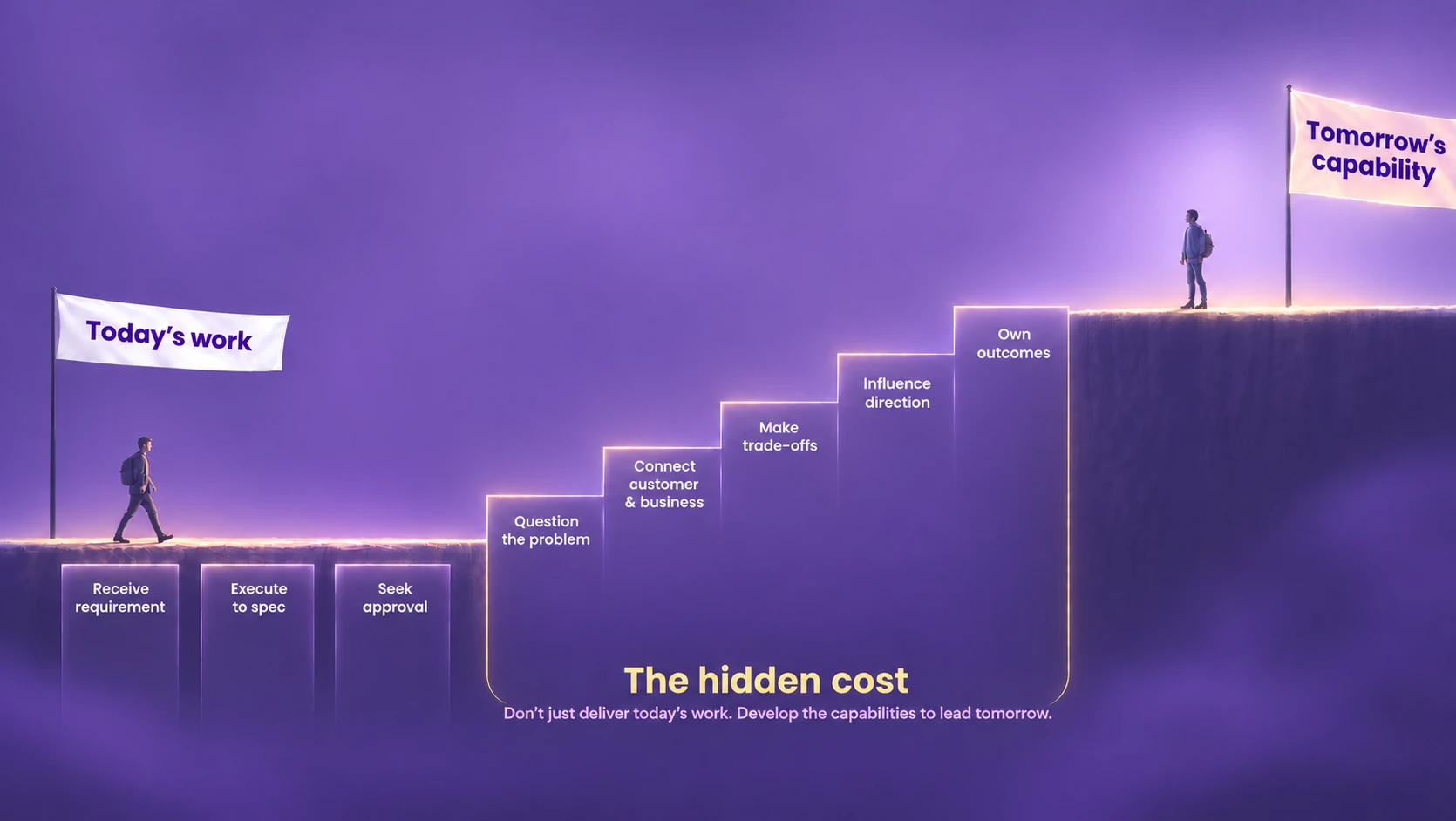
But when this pattern repeats for years, professionals become very good at responding to requirements, delivering reliably and knowing when to seek approval.
What they may get less opportunity to practise is questioning whether the requirement addresses the right problem, connecting customer behaviour with business objectives, recommending a direction, making trade-offs and taking responsibility for what happens afterwards.
Capability development in organisations therefore happens not only through formal learning.
It happens through the work people are repeatedly allowed to do.
The cost is hiding in plain sight
An organisation can usually identify poor performance.
It is much harder to see what never developed.
There is no dashboard showing the business understanding that could have grown, the product direction that might have been influenced, the problem that was never reframed or the decision that could have been made without escalation.
The organisation sees what people contribute today.
It rarely sees what they might have become capable of contributing.
That cost is hiding in plain sight.
AI may widen the gap
AI makes this even more important.
Research can be synthesised faster. Concepts, analysis, documentation and prototypes can be produced with far less effort.
That is valuable.
But if the released capacity is used only to produce more output, organisations may become more efficient without becoming more capable.
Execution gets faster while people get fewer opportunities to deal with ambiguity, question assumptions, make trade-offs and take responsibility.
The deeper opportunity is to use AI to free professionals for higher-value work: understanding the business problem, investigating human behaviour, connecting decisions across functions, examining consequences and recommending direction.
AI should not only help people execute faster.
It should create room for them to contribute at a higher level.
Product and design capability must move upstream
For product and design professionals, this shift matters.
The value of design cannot remain limited to responding well to requirements. Strong design leadership increasingly requires the ability to question the problem, understand business context, recognise behavioural patterns and influence what should be built.
Product leadership similarly requires more than managing delivery. It demands clarity about why an opportunity matters, what trade-offs are acceptable and what outcome the organisation is trying to create.
These capabilities extend beyond craft.
They include business understanding, problem framing, systems thinking, decision-making and leadership.
That is a broader professional territory.
Build capability before the responsibility arrives
One of the central ideas behind yuj.dna is that capability development should not begin only when someone receives a bigger title or greater responsibility.
The work itself should help people become ready for what comes next.
Organisations therefore need to ask not only what people are delivering today, but what the current way of working is helping them become capable of tomorrow.
Because one of the biggest hidden costs in an organisation may be the capability its people never get the opportunity to build.
And that cost compounds over time.
Perhaps the more useful leadership question is:
What must organisations change if they want design and product teams to frame better problems, influence direction and own outcomes?