
What makes a professional capable of contributing at this level?

Prasadd Bartakke

What Makes Your Expertise Valuable Before Business Decisions Are Made?
Imagine being invited into a conversation while the business is still deciding what to do. The problem is being understood. Opportunities are being explored. Decisions about customers, products, investments and business direction are taking shape. Your presence matters because people trust your ability to help them think through the situation and find a better way forward.
What makes a professional capable of contributing at this level? And how does someone develop that capability?
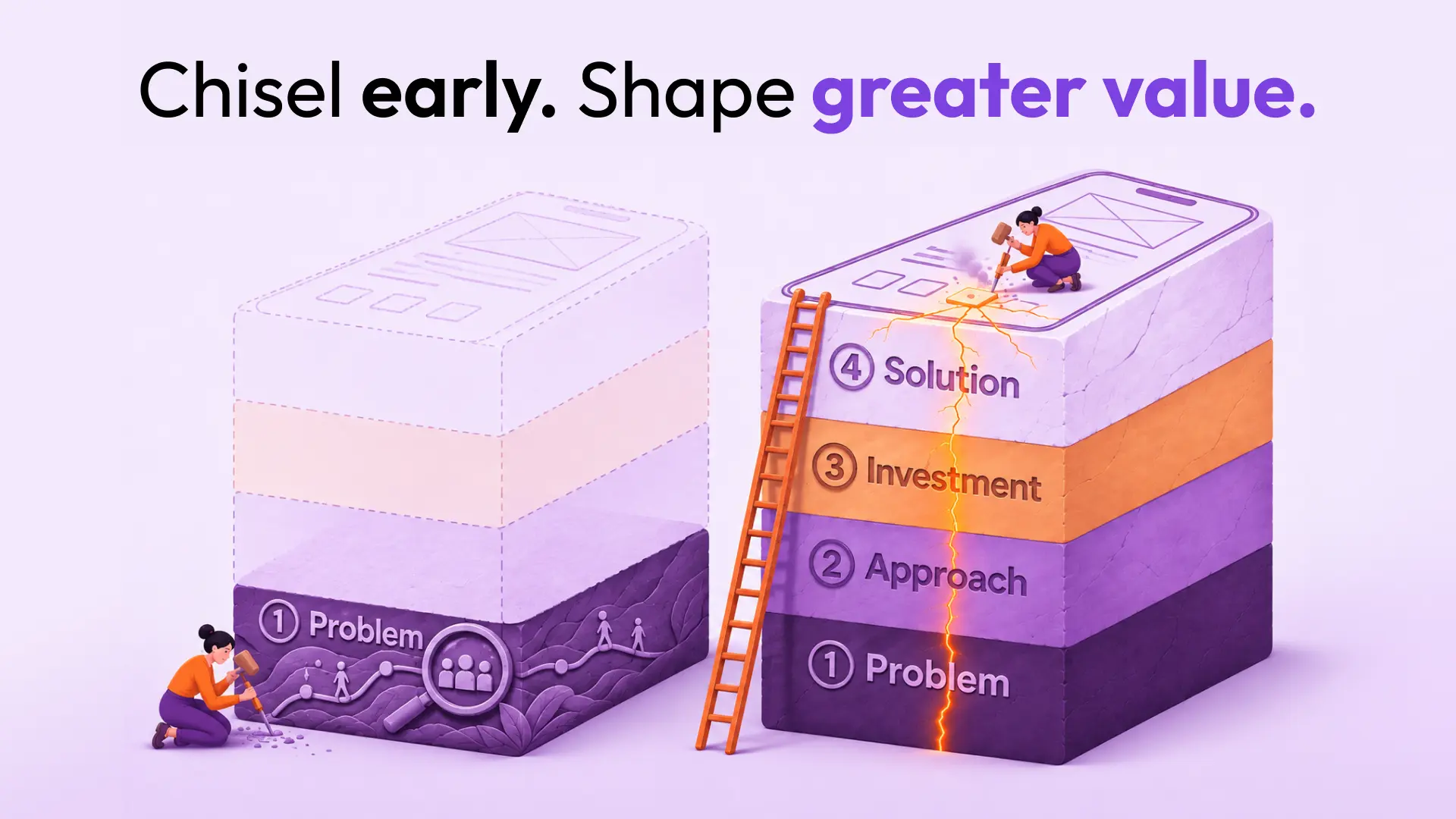
Important decisions happen before the work begins
Think about the last major assignment you received. Perhaps you were asked to improve a customer journey, conduct research, design a product, build a feature or analyse a business requirement. By the time the assignment reached you, how much had already been decided?
The problem may have been defined. The approach agreed. The budget approved. Perhaps even the solution was chosen. You brought your expertise and delivered good work. But consider what might have changed if you had been involved earlier.
Could the problem have been understood differently? Could another opportunity have created greater value? Were there consequences or dependencies that needed to be considered before the investment was made?
Your expertise becomes more consequential when it helps shape the decisions behind the work.
Understanding the larger business problem
Consider a company trying to improve customer adoption of its digital service. The team proposes a simpler interface. Designers improve the experience, engineers implement the changes and the product manager coordinates the release. The work may be excellent.
But customers may be struggling for reasons beyond the interface. Perhaps the service does not address their most important needs. Perhaps pricing, policies or operational processes create barriers. Improving the interface alone may leave the larger problem unresolved.
Someone needs to investigate what customers are trying to achieve, what prevents them from doing so, what the business needs to change and which possibilities deserve investment. That demands thinking across several areas of expertise.
Understanding human behaviour helps uncover needs that customers may struggle to express. Business understanding helps establish what creates value. Product and systems thinking helps reveal connections, dependencies and consequences. Creative exploration makes it possible to consider different ways forward.
The quality of the solution depends heavily on the quality of thinking that shapes it.
When the problem is larger than your function
Over the years at YUJ Designs, we have worked on complex enterprise challenges involving automotive HMIs, air traffic control, smart cities and industrial systems. These environments have reinforced an important lesson for me. A good solution demands much more than a well-designed interface or a technically sound feature.
Think about an automotive interface. Human attention, vehicle behaviour, safety, technology and the larger driving experience must be considered together. In industrial systems, a decision about one part of an operation may affect several others.
The challenge is to understand these connections, examine different scenarios, work through competing needs and help people make informed decisions. The same thinking applies to business services, digital products, enterprise software and intelligent systems. A professional who understands only the assigned part may contribute excellent work. Someone capable of understanding the larger situation can also influence the direction of that work. And that broader contribution does not require abandoning your craft or becoming a manager.
AI is changing the value of professional capability
AI is making many execution activities faster and more accessible. Research, analysis, content creation, coding, prototyping and other tasks can increasingly be supported by intelligent tools. But making something faster does not establish whether it deserves to be created, how it should work or what value it should produce.
As organisations adopt AI, professionals face larger questions. Which opportunities deserve attention? How should human and AI capabilities work together? What decisions should remain with people? How will the system affect customers, employees and business outcomes? These decisions require understanding the larger situation, examining evidence, working across functions and considering consequences. The World Economic Forum's Future of Jobs Report 2025 reinforces the importance of these capabilities. Among surveyed employers, 69% identified analytical thinking as a core skill, while 61% identified leadership and social influence. Technology capabilities matter. So does the human ability to make sense of complex problems and guide what technology is used to achieve.
Becoming someone the business seeks out
Think about the conversations happening around you. Are you involved while opportunities are being explored? Are people asking for your view when the problem is still unclear? Can you offer possibilities that others may not have considered?
Imagine becoming someone the business actively seeks out while important decisions are still taking shape. That level of trust grows when your thinking consistently adds value.
You develop the ability to understand business and human problems, connect information across functions, examine alternatives, communicate your reasoning and take responsibility for outcomes. These capabilities grow through real experience, practice, questioning, feedback and reflection. They can be developed deliberately.
Organisational leaders have a responsibility here as well. If professionals enter the conversation only after important decisions are made, they have fewer opportunities to develop or demonstrate these capabilities. Leaders need to give people access to business context, meaningful problems and opportunities to contribute beyond assigned tasks. Better capability and greater opportunity to use it must grow together.
Why this matters to me
Working with enterprises across industries has made me increasingly aware of how much the quality of thinking influences the quality of decisions, products, services and business outcomes. It has also strengthened my desire to take this discipline beyond client projects and help many more professionals develop it. That thinking has shaped yuj.dna, our capability transformation initiative.
Through Product & Experience Leadership in an AI-enabled World, professionals work on real enterprise challenges to develop broader business, product, human behaviour, systems and leadership capabilities. The program includes more than 30 guided hours over 12 weeks, with expert coaching focused on how participants think, decide and apply their learning. Our second program, Human-AI & Agentic Systems Design, focuses on identifying valuable AI opportunities and designing how people, AI agents and enterprise systems work together, with appropriate responsibility, control and oversight. These journeys support professionals who want to influence larger business outcomes and organisations that want their teams to become capable of doing so.
What are you becoming capable of contributing?
Perhaps the most useful reflection is to look at the work you are already doing. Think about the problems you are trusted to handle, the decisions you influence and the opportunities you have to contribute before a direction is chosen. What would make your expertise valuable in those earlier conversations?
Become someone the business wants involved while it is still deciding what to do.
If this resonates with your professional ambitions or the capabilities you want to develop across your organisation, explore the programs.
You can also write to me at prasadd@yujdna.com to exchange perspectives or discuss your team's capability-development needs.