
Before You Add More AI, Examine How Teams Think Together

Prasadd Bartakke

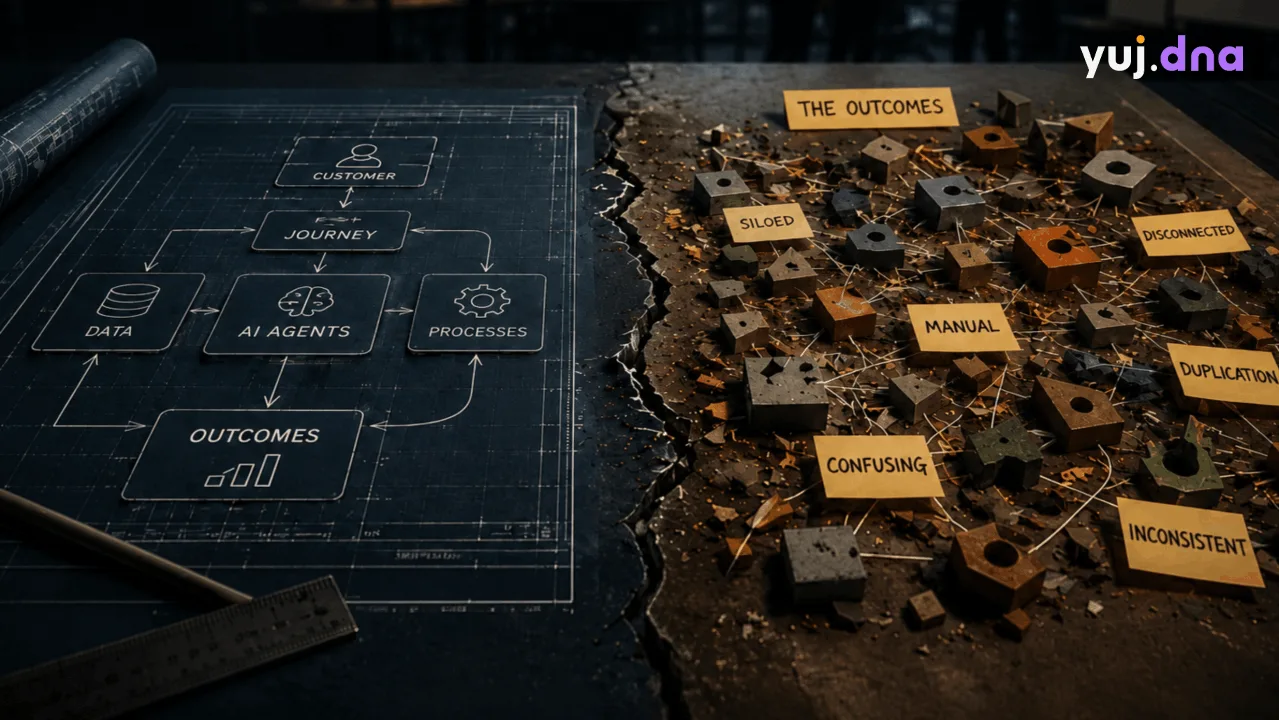
Teams are asked to move quickly. AI pilots begin. Automation ideas start flowing. The intent is genuine.
But in many organisations, the shared picture is still not ready. Important unknowns sit below the momentum.
One leader imagines business change. Product teams hear roadmap pressure. Engineering hears delivery urgency. Operations hears process change. Design teams hear workflows and interfaces. Business teams expect measurable outcomes.
Everyone starts working. But not everyone is moving toward the same outcome. Teams unknowingly start solving different versions of the same problem.
The challenge
In the Agentic AI era, fragmented thinking can become expensive quickly.
AI can automate workflows, trigger actions, make recommendations, support decisions, and connect tasks across teams. Confusion no longer stays contained inside one discussion.
It moves into approvals, alerts, customer journeys, service processes, internal tools, and everyday user behaviour. AI can turn small gaps in thinking into large operational consequences.
Why this happens
There is not necessarily any lack of effort. People are working. Meetings are happening. Work is moving. But many teams are still operating around important unknowns.
What exactly are we trying to deliver? What should the final outcome look like? Who is the real customer, user, or beneficiary? What business result matters most? What should become simpler? What should stay human? How should the full experience come together when everything goes live?
When these questions remain unresolved, teams often move ahead assuming clarity will emerge along the way. But businesses do not have endless time, energy, or resources.
Leadership expects teams to shape the idea while building it. Teams expect clarity to appear as work progresses. Product managers expect different groups to align along the way. But expectation is not orchestration.
Design was always meant to shape direction
Many organisations have unintentionally weakened one of the very capabilities that could have helped teams think together better. The meaning people give design needs a serious reset.
Somewhere along the way, many organisations reduced design to interface execution instead of using it to shape direction, decisions, and experiences more thoughtfully.
Most people still connect design with screens, colours, layouts, flows, and visual polish. Many designers themselves have also been trained to see their role mainly through execution.
Design is the science of understanding how people, decisions, workflows, business goals, technology, and intelligent systems affect each other.
It helps teams see where people may get confused, where trust can break, where handoffs can fail, where AI should act, where humans should decide, and where complexity can create more work instead of reducing it.
Design helps organisations think through consequences so execution can create real impact.
“Good design helps organisations see what they are really trying to create before they build it.”
That is why the role of design cannot remain limited to UI execution. The organisations handling complexity well already recognise this.
In the Agentic AI era, organisations need people who can help teams think together before work spreads across products, operations, workflows, and customer experience.
The real advantage will increasingly come from organisations that can clarify direction early, simplify complexity before scaling it, and connect the right pieces together thoughtfully.
The organisations handling this transition well are investing not only in AI capability, but also in how teams think, align, orchestrate, and make decisions together. Much of this exploration continues inside yuj.dna today.
In the Agentic AI era, the organisations that stand out are the ones that make informed moves and connect the right pieces together.