
Product Design Is Not the Same as Feature Production

Prasadd Bartakke

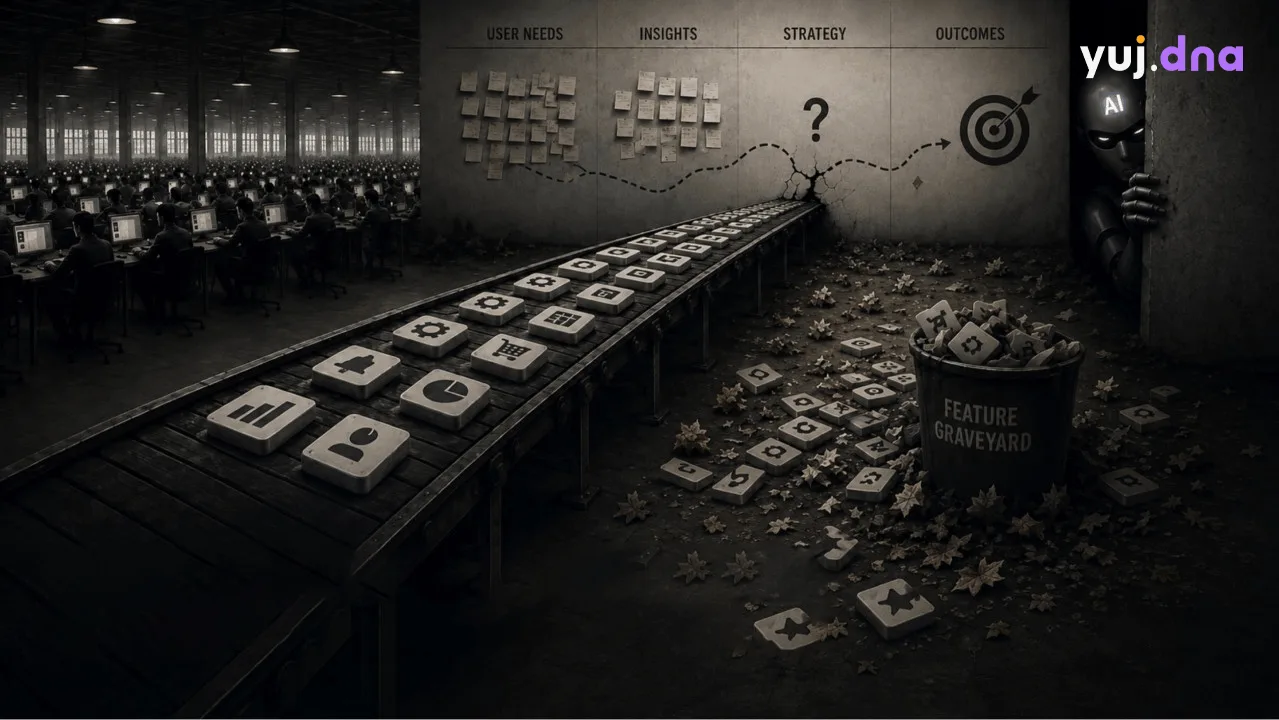
Most organisations today are filled with capable professionals trying to create meaningful products. Product managers drive roadmaps. Designers shape experiences. Developers deliver efficiently. Researchers gather findings. Leadership teams push transformation agendas and growth targets.
On the surface, the machinery appears impressive.
Features continue shipping. AI capabilities get integrated. Design systems mature. Product conversations become more sophisticated. Dashboards improve. Delivery accelerates.
Still, many organisations struggle to create products that genuinely influence adoption, trust, behaviour, operational simplicity, or long-term business value.
The issue rarely comes from lack of intelligence or effort.
It begins when every function becomes highly effective within its own boundary while very few people remain responsible for the integrity of the larger product ecosystem.
Architecture offers a useful parallel. A building may look visually impressive while structural pressure accumulates through hundreds of small compromises made across different layers of construction. Individually, each decision may appear reasonable. Over time, the structure starts carrying invisible stress.
Product ecosystems behave similarly.
Roadmaps expand. Features multiply. Competitive parity becomes an obsession. Teams study what others are launching and rapidly reproduce similar patterns hoping relevance will follow.
In many environments, product development slowly turns into industrialised feature production.
“Capability without stewardship multiplies complexity.”
Peter Drucker once remarked that “there is nothing quite so useless as doing with great efficiency something that should not be done at all.” Many organisations unknowingly drift into this pattern. Teams become highly efficient at feature production while clarity around behavioural impact, operational consequences, and long-term ecosystem quality gradually fades into the background.
This creates an important distinction.
Building products and shaping product direction are not the same discipline.
Many teams spend enormous energy improving flows, interactions, onboarding journeys, dashboards, and AI-enabled capabilities without sufficiently examining the larger behavioural and operational consequences surrounding them.
What human response are we actually trying to influence? What friction genuinely affects trust? Which assumptions continue shaping the roadmap without challenge? What operational burden are current decisions quietly creating? Who remains responsible for the integrity of the overall experience?
These questions demand stewardship.
The strongest architects study load-bearing systems before arranging beautiful spaces. Doctors diagnose patterns before prescribing treatment. Fitness experts understand that every body requires different conditioning, recovery, nutrition, and stress management.
Strong product ecosystems require similar depth of observation.
Still, many organisations unintentionally condition professionals into narrower participation. Designers become interface executors. Product teams become roadmap administrators. Researchers become insight suppliers. Engineering teams become implementation engines. Everyone contributes.
Few step forward to shape coherence across the whole.
Over time, professionals begin sensing the consequences internally. They notice feature accumulation without meaningful differentiation. They notice product experiences becoming heavier, fragmented, and operationally difficult to sustain. They notice users behaving differently from what presentation decks predicted.
Most importantly, many begin feeling disconnected from influence itself.
This may explain why many intelligent professionals eventually feel frustrated with their growth despite working continuously. The issue often extends beyond capability alone. It connects to ownership, courage, articulation, judgement, systems awareness, and the willingness to participate beyond assigned mandates.
Some individuals evolve differently.
You can usually recognise them quickly. They ask uncomfortable questions early. They connect behavioural insights to business implications. They study patterns beyond isolated screens. Stakeholders listen when they speak because their thinking carries structural depth instead of surface-level opinion.
Most importantly, they care about the integrity of outcomes, not only the completion of tasks.
As intelligent systems become more integrated into products and services, this distinction may become even more important. Organisations will increasingly need people who can connect human behaviour, operational realities, business direction, technological capability, and long-term experience quality together.
“Building products and shaping product direction are not the same discipline.”
Products rarely fail because organisations lack activity. Many struggle because nobody remains responsible for the integrity of the whole.